Period Health - What we learn from Tracking
It’s Period Health month here at A D Acupuncture. And if you haven’t seen already, check out my last post, as this is a continuation in the series. Last week was all about tracking the period and how to do that effectively.
This week we are discussing what is it we can learn from tracking the period. So, if you have tracked your cycle for a while, or just generally know the deal for you, then its time to understand what that means in terms of period health.
Disclaimer: I’m not talking about every possible scenario here, I’m just discussing the most common. If you would like to talk about your cycle, and get personalised support, then get in touch to see how I can help. This is just a starting place!
I’m going to be discussing this using both Western Medicine (WM) and Traditional Chinese Medicine (TCM). You may not understand the terminology, but whats important is identifying what’s true for you and hopefully learning something. Next week, we are discussing how we take this terminology and actually start to help the body!
Traditional Chinese Medicine
A few things to understand about TCM and this post. First off, TCM is incredibly complicated and therefore this post is an overview, giving you a rough insight and trying to make TCM useable to those without training.
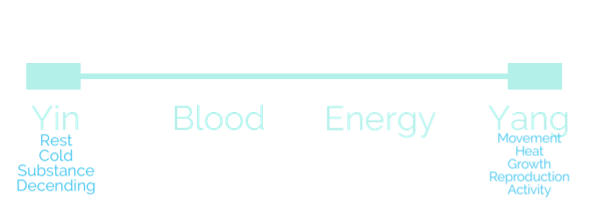
Second, we are working with four different types of imbalances in TCM. These are Energy, Blood, Yin and Yang. These exist on a scale as shown in the diagram below.
Western Medicine
So, back to biology class! Our cycle can be split into two sections - before and after ovulation.
Follicular Phase
Before ovulation is called the follicular phase. This is around 14 days long in a regular 28 day cycle. It includes the bleed, and then the time that the body prepares and releases an egg. It is called the follicular phase as the ovaries produce follicles, and the largest follicle, during ovulation, releases an egg. Within TCM, this is seen as the Yin stage of the cycle.
Luteal Phase
After ovulation is called the luteal phase. Again, around 14 days long. This is the time that the body prepares for implantation of an embryo. Therefore the lining of our endometrium (uterus lining) builds. If there is no fertilisation, the hormones do not maintain the lining and it will begin to shed. This is now the start of the next cycle. Within TCM this is seen as the Yang stage of the cycle.
Basal Body Temperate (BBT)
BBT is something that can be used for tracking the period as our body temperature is effected by different stages of the cycle. Body temp is lowest at the start of the period, before peaking at ovulation and maintaining a higher BBT for the rest of the cycle. These temperature changes correlate to Yin and Yang. Yin relates to cold, stillness, and blood. While Yang relates to heat, energy, movement and growth.
So, from tracking when we ovulate and how long our cycle is, we can learn which part of our circle is not quite right.
Cycle Length
If the follicular is to long, it is often due to Blood or Yin Deficiency. This is the Yin and Blood part of the cycle, and therefore if these are in short supply, it can take longer for the body to ovulate.
A luteal stage defect usually means that this stage is too short. This can have big impacts on fertility as there won’t be enough time to build the endometrial lining to support a pregnancy, This usually relates to Yang Deficiency. This is because this is the Yang stage of the cycle. And without it we have a deficiency of growth. A long luteal phase suggests pregnancy.
Myth Buster - your period isn’t late, your ovulation is! That’s right, after ovulation you will have a bleed no later than 16 days later if you haven’t conceived. The luteal phase is a lot more reliable in that sense. The follicular phase however can be tricky! So chances are its your ovulation that’s late, and your period is right on time.
I don’t know when I ovulate!
It can be hard to track this, and it may be something you just are not inclined to do. If so, then lets just think days.
Long - Deficiency, probably of Blood or Yin. If you gets lots of pain too - then its stagnation of Blood making the cycle longer.
Short - Heat, I’m not really delving into heat and cold in this post, but they do affect the cycle. If you think this applies to you, get in touch to find out more.
Irregular - sometimes short, sometimes long. It could be Energy or Blood Deficiency. This is often a more complicated pattern so get in touch for personalised help to regulate the cycle.
Energy Levels and Mood
If you have tracked fatigue connected with the cycle, it will be important to know when. If the fatigue is just before the period but after ovulation, this suggests it is Yang Deficiency. if you also have a short luteal phase, this supports this too.
If the fatigue comes after or during the period and before ovulation, this is usually a sign of Blood Deficiency. Therefore the loss of blood is felt much more by the body, resulting in tiredness. To note however, energy levels are naturally higher in the second part of our cycle, and lower in the first half. But fatigue or lethargy that negatively impacts you, is something to address.
Mood follows a similar pattern. Dips in mood, or increase in anxiety before bleeding but after ovulation is a Yang or Energy Deficiency.
Dips in mood or increase in anxiety before ovulation is a Yin or Blood Deficiency.
Pain
Probably the biggest topic of period health ever! Pain, anywhere in the body, in TCM is stagnation of blood or energy. If movement is uninterrupted in the body, then we cannot have pain. So pain = stagnation.
Keep reading other sections to find more clues to whether it is blood or energy.
PMS
PMS as a generalisation is Energy stagnation.
Colour, clots and flow
Clots and dark coloured blood suggests stagnation of blood.
Pale blood suggests Blood Deficiency.
A very light flow, and/or a short bleed can suggest blood deficiency.
A very heavy flow, and/or long bleed can suggest energy deficiency.
So there we have it, the very basics to help you start to diagnose using your cycle tracking! As I said before, this is just a guide, for personalised, accurate advise, get in touch with me or see your local practitioner. Next week, I will be sharing how we can start to remedy some of these imbalances!